Verification is the senior engineer's AI moat
AI makes code cheaper to produce, but trusted production changes still need verification, judgment and clear ownership.
AI makes code easier to produce. It does not make software easier to trust. That distinction is becoming a serious career signal for senior engineers because the cost of a wrong production change has not dropped with the cost of a draft.
Stack Overflow's 2025 Developer Survey captures the tension. More developers actively distrust the accuracy of AI tools than trust it: 46 percent distrust, 33 percent trust and only a small fraction highly trust the output. Experienced developers are cautious because they still own released changes.
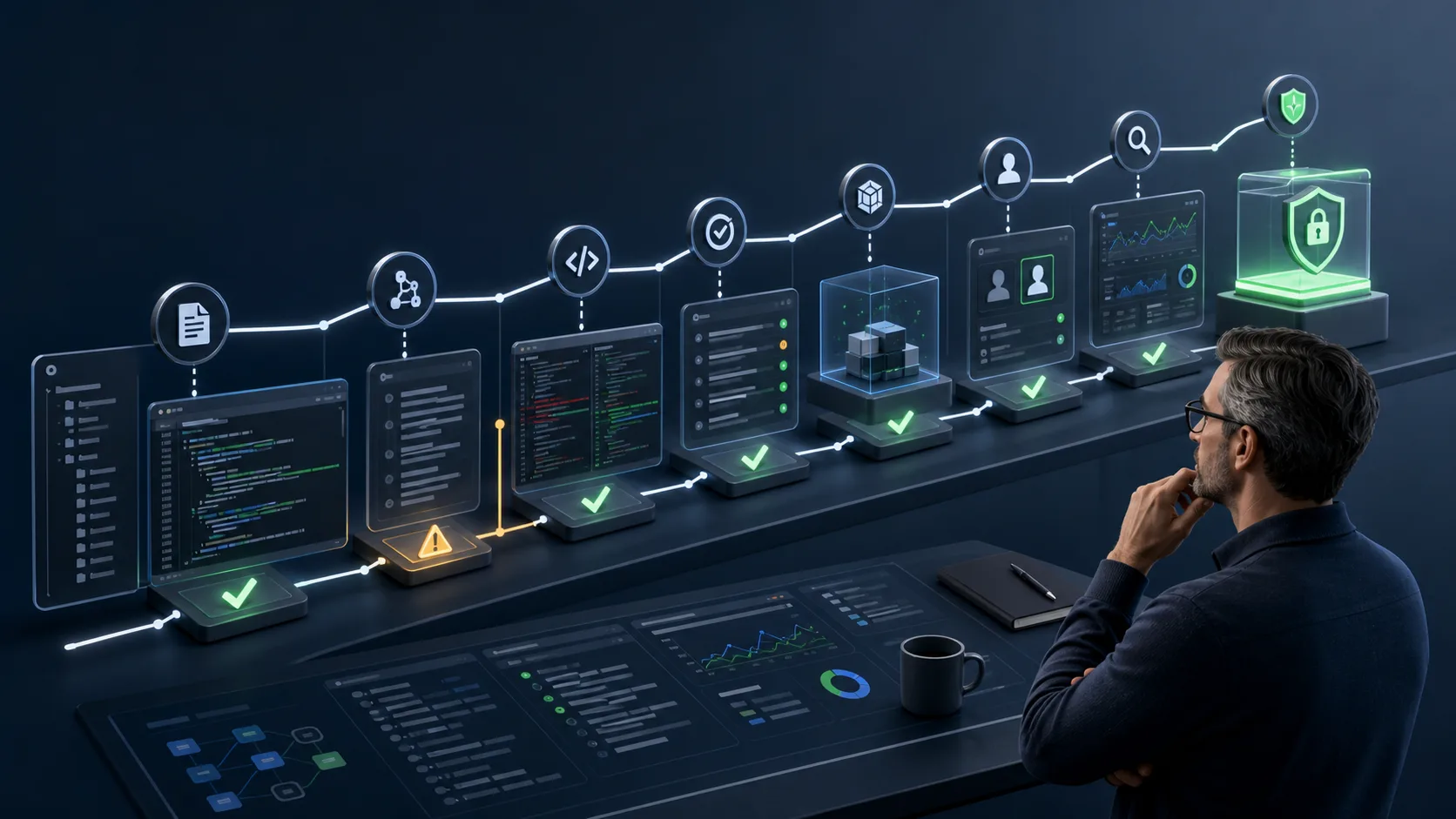
The job moves toward proof
A model can generate a migration, Kubernetes manifest, Solidity helper, monitoring script, GitHub Action or API endpoint. The senior question is whether the change respects the actual system: auth boundaries, race conditions, gas assumptions, chain behavior, dependency versions, rollback paths and observability.
Verification cannot sit at the end as a polite review step. In AI-native engineering, verification is part of the workflow design. The agent can draft and compare. The system has to check. The human has to approve the parts where ownership or irreversibility matter.
Build an evidence ladder
A strong AI workflow gives reviewers more than a generated answer. It moves through evidence levels: source context, model assumptions, generated change, automated checks, human review and post-change monitoring. Each level should either strengthen confidence or stop the workflow.
This matters because AI mistakes often look coherent. A migration can preserve syntax and break retention. A runbook update can sound helpful and remove the one escalation path that actually works. A transaction explanation can be fluent and still hide the wrong target address.
- Source context: files, logs, tickets and docs used by the agent.
- Assumptions: constraints the model inferred but cannot prove.
- Checks: tests, simulations, static analysis or policy gates.
- Approval: a named reviewer and the evidence they accepted.
- Monitoring: the signal that confirms or contradicts the result after release.
What strong verification includes
- Static analysis, type checks and linting for basic correctness.
- Unit, integration and end-to-end tests tied to the actual user or operator journey.
- Security scans and permission review for tools, secrets and production access.
- Simulation before deploys, Safe transactions, contract interactions or high-impact configuration changes.
- Human approval for irreversible, costly or security-sensitive actions.
- Post-deploy monitoring, rollback paths and audit logs that explain what happened.
Why blockchain teams should be stricter
On-chain systems punish weak verification. A generated helper that passes a superficial test can still break accounting assumptions. A plausible Safe transaction can still point at the wrong module. A monitoring script can still miss the only signal that matters during a liquidity event or oracle incident.
For this reason, AI should often prepare evidence before it prepares action. It can collect diffs, simulations, event traces, runbook status and signer context. Execution waits for deterministic checks and accountable review.
A practical AI verification checklist
- What did AI change, and which assumptions did it make?
- Which production systems, permissions or user journeys can be affected?
- Which tests or simulations prove the change works in context?
- Which reviewer owns approval, and what evidence do they need?
- What log will show the action path after the fact?
- What rollback or manual override exists if the output is wrong?
A faster draft is useful only when the verification path is explicit enough to catch the wrong draft.
Further reading
Nexuain practical implication
AI velocity without verification is not a moat; it is operational risk. Block private-key access, chainId mismatches, failed simulations, unapproved Safe module or guard changes, and any fund movement without human approval.
Internal links
Source registry
Need help applying this to your launch or workflow?
Request a technical review and we will map the safest first step.