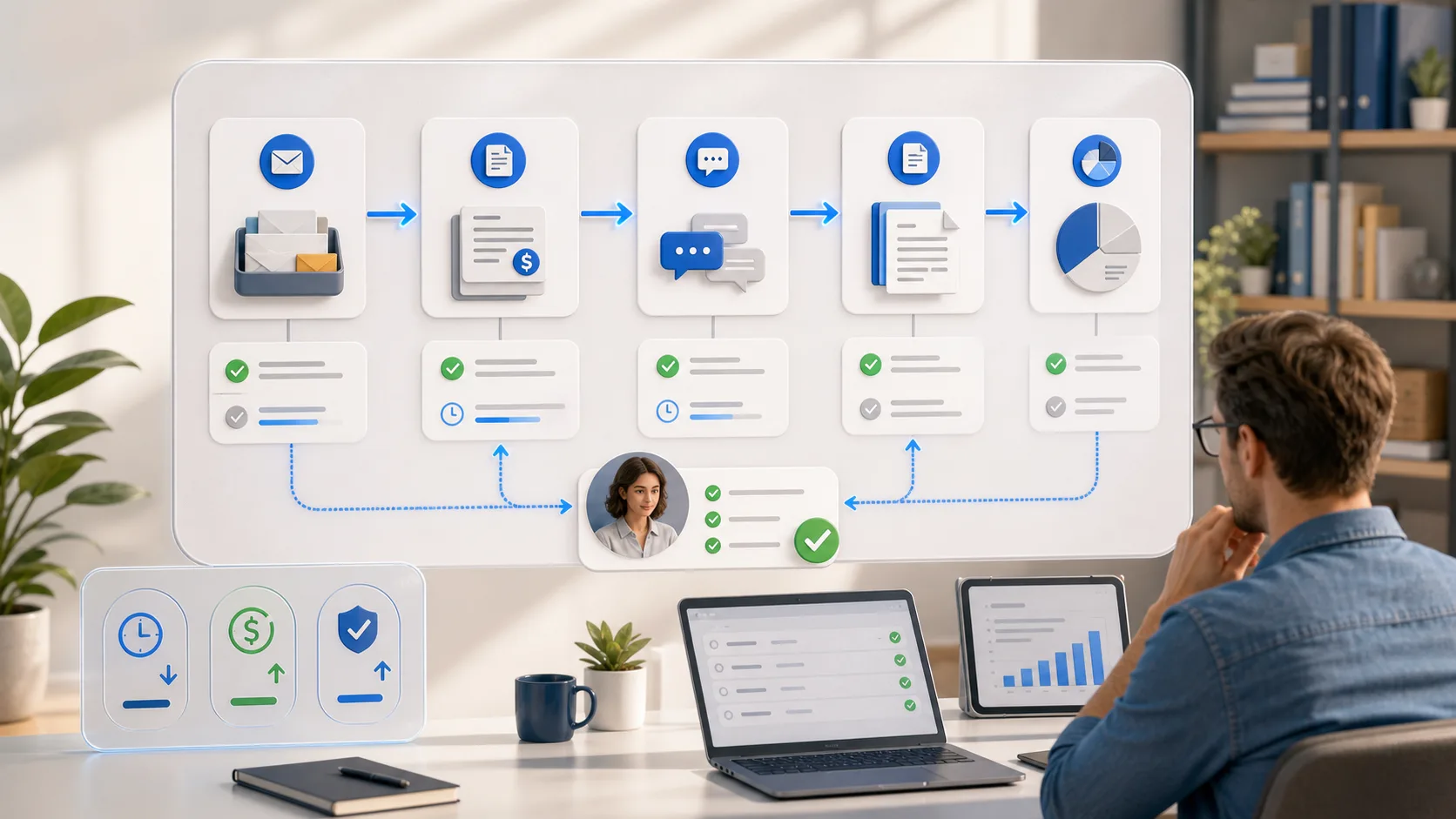
Experienced AI users compound faster
Senior engineers need repeatable AI workflows, not random prompts, to stay useful in an AI-native software market.
AI skill compounds when people turn usage into a repeatable workflow. A random prompt may solve a small task. A workflow improves how you handle an entire class of tasks: debugging incidents, reviewing pull requests, writing tests, preparing releases or documenting handoffs.
Anthropic's March 2026 Economic Index report points in that direction. It found that longer-running Claude users appear to develop habits and strategies that help them use the model better. The report says more experienced users attempt higher-value tasks and are more likely to elicit successful responses, including a 10 percent higher success rate for that group.

A prompt ages. A workflow improves
A prompt pasted into a chat box is hard to improve because the surrounding process is invisible. You cannot tell which context mattered, which instruction failed, which check caught the mistake or which decision the human made after the output.
A workflow gives you something to tune. You can improve the context brief, remove a weak instruction, add a test gate, change the review checklist or record a decision for the next run. After enough cycles, the system gets better even if the model stays the same.
The advantage is operational memory
Experienced AI users stop treating every task as a fresh chat. They preserve context packets, review notes, failure examples, accepted outputs and rejected outputs. That memory reduces setup time and makes the next run more precise.
This is why the gap between casual and experienced users widens. The casual user asks again. The experienced user improves the loop: better retrieval, sharper constraints, stronger checks and a shorter path to human approval.
- Save the context that actually changed the answer.
- Record the model mistake that created rework.
- Update the checklist after every missed signal.
- Keep one example of a good answer and one example of a rejected answer.
What a senior workflow looks like
- Start with a clear task boundary and a short statement of the risk.
- Load only the context the model needs: files, logs, tickets, specs or runbooks.
- Ask for assumptions before accepting implementation advice.
- Use tools to inspect the repo or runtime instead of trusting memory.
- Run checks that match the risk: tests, typecheck, build, smoke, simulation or review.
- Write down the decision and the evidence that supported it.
The organization version
Deloitte's 2026 Global Human Capital Trends makes a similar point at company scale. It argues that AI value comes from reimagining work around humans and machines together, and reports that organizations taking a tech-focused approach are more likely to miss return expectations than those taking a human-centric approach.
For an engineering team, human-centric does not mean soft. It means the workflow names the human decision points. The agent can gather evidence, draft options and run bounded checks. The engineer decides when the result is safe enough, incomplete or blocked.
Build a portfolio of loops
Pick one repeated task and formalize it. Incident review is a good starting point: define the inputs, the logs, the timeline format, the hypotheses, the checks and the final handoff. Then reuse the loop. Improve it when it misses a signal or saves time.
After a few months, this becomes more valuable than a list of tools. It proves that you can redesign work, preserve ownership boundaries and improve the system after each run. That is the difference between using AI and operating AI.
The goal is not a longer prompt. The goal is a better loop: context, action, verification, decision and memory.
Further reading
Nexuain practical implication
Treat AI work as a controlled workflow: define the tool boundary, capture evidence, assign a human owner and verify the output before it reaches production.
Source registry
- OWASP 2025: source used to check LLM application risks and agent tool boundaries. Nexuain interpretation: turn the reference into owners, evidence, permissions and human review.
- NIST 2023: source used to check AI risk management and governance framing. Nexuain interpretation: turn the reference into owners, evidence, permissions and human review.
- CISA 2023: source used to check secure defaults and software accountability. Nexuain interpretation: turn the reference into owners, evidence, permissions and human review.
Related blog routes
Need help applying this to your launch or workflow?
Request a technical review and we will map the safest first step.