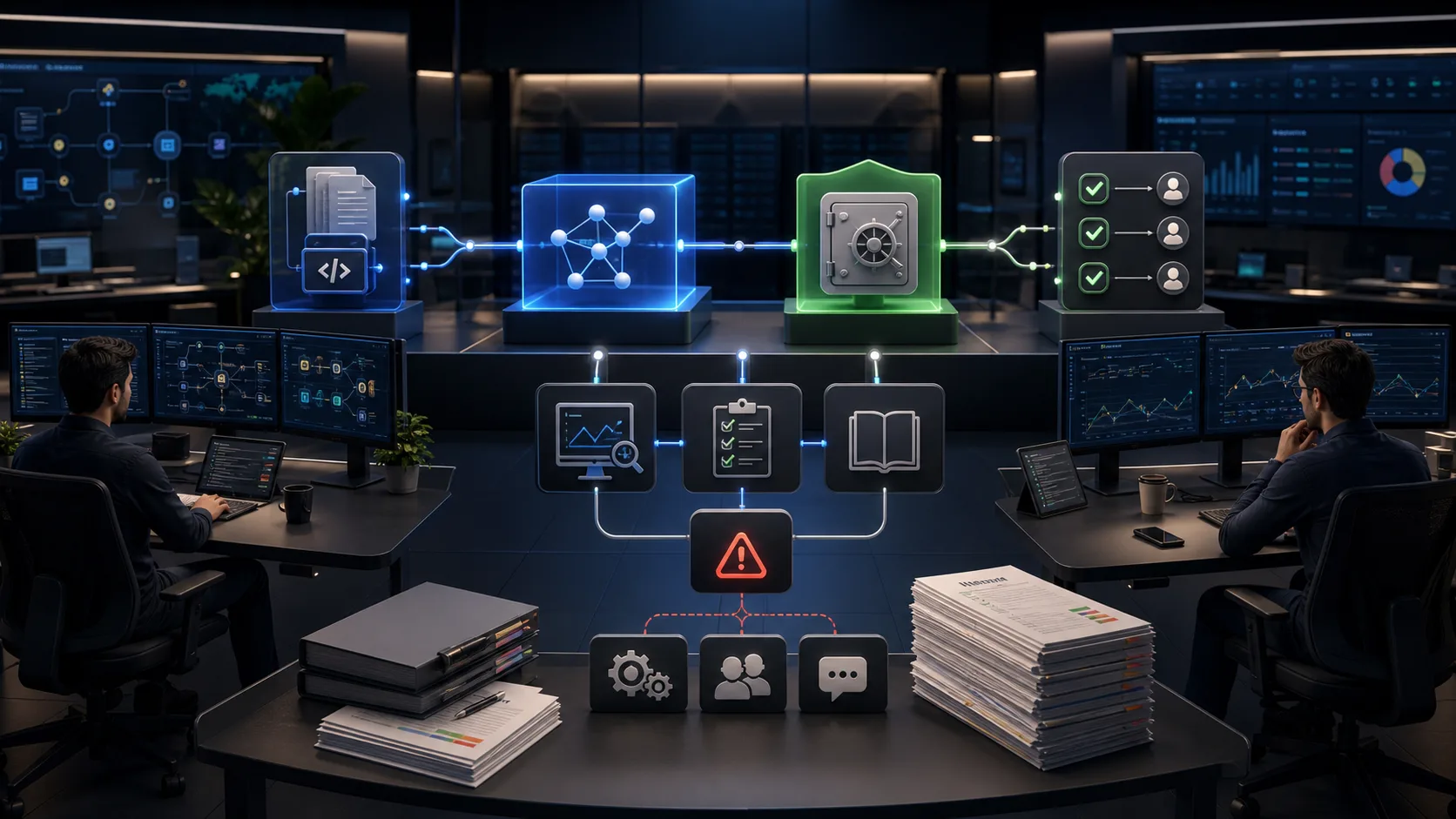
Before you launch an ERC-4626 vault: accounting, testing and operational risks
An educational readiness checklist for ERC-4626 vault teams covering accounting, tests, operations and launch controls.
ERC-4626 gives vault teams a useful interface, but the interface does not remove the need to understand accounting, rounding, previews, share pricing, deposit limits, strategy behavior and operational response. A launch can be technically valid and still operationally fragile.

Problem
Many vault launches focus on contract deployment and UI wiring. The harder questions arrive later: what happens when assets are donated, previews drift from execution, strategy accounting changes, deposits are paused, or a downstream integrator assumes behavior your vault does not provide?
Practical checklist
- Test deposit, mint, withdraw and redeem flows across small, large and edge-sized amounts.
- Verify preview functions against execution paths, including fees, rounding and paused states.
- Document assumptions for share price, total assets, strategy reporting and loss recognition.
- Review donation, inflation and griefing scenarios that can distort accounting or user expectations.
- Define who can pause, upgrade, change limits or rotate strategy permissions, and how those actions are approved.
- Prepare dashboards for assets, shares, limits, queued operations, oracle status and abnormal deltas.
Implementation notes
A launch readiness review should connect smart contract behavior with operational workflows. Tests should prove accounting invariants, but runbooks should also explain what operators do when the invariant is threatened or a dependency changes.
Mistakes to avoid
- Assuming ERC-4626 compatibility means every integrator will handle your vault correctly.
- Leaving pause or limit changes undocumented until an incident.
- Testing happy paths only.
- Treating dashboard gaps as a post-launch detail.
- Publishing yield or safety claims that operations cannot support.
How Nexuain helps
Nexuain helps teams review vault launch workflows, operator runbooks, dashboards, Safe approvals and backend jobs around the vault so operational blind spots are visible before go-live.
Nexuain practical implication
Map contract behavior to operating controls: Safe context, dashboards, runbooks, reviewer ownership and rollback decisions need the same review path as code.
Source registry
- Ethereum Improvement Proposals 2021: source used to check the ERC-4626 interface and vault accounting expectations. Nexuain interpretation: turn the reference into owners, evidence, permissions and human review.
- OpenZeppelin 2026: source used to check vault implementation patterns and inflation-attack context. Nexuain interpretation: turn the reference into owners, evidence, permissions and human review.
- Safe 2026: source used to check Safe transaction tracking and signature collection. Nexuain interpretation: turn the reference into owners, evidence, permissions and human review.
- Ethereum Improvement Proposals: EIP-4626: Tokenized Vault Standard
- OpenZeppelin: ERC-4626 documentation
- Safe: Safe Transaction Service API
Related blog routes
Need help applying this to your launch or workflow?
Request a technical review and we will map the safest first step.